
Moca Chain mainnet is live: a Layer 1 built for privacy-preserving identity for businesses and AI agents
Moca Chain mainnet is live: an EVM-compatible Layer 1 blockchain for privacy-preserving digital identity, verifiable credentials and AI agents, with AIR as its business integration layer.
Moca Network has launched Moca Chain mainnet, an EVM-compatible Layer 1 blockchain purpose-built for digital identity and verifiable credentials. The chain runs the full credential lifecycle as network functions: issuance, verification, updates and revocation. AIR, Moca Network's product layer for identity, money and loyalty, is how businesses put it to work.
With mainnet live, Moca Network is putting its full build focus into AIR. Every business that issues or accepts credentials through AIR does so on Moca Chain, so each new AIR integration adds activity to the network.
In brief
- Live today: Moca Chain mainnet (EVM chain ID 2288), with MOCA as the native gas token, RPC access, a block explorer and a ChainList listing.
- Identity at the protocol layer: issuing, verifying, updating and revoking credentials run on the network's native identity contracts and storage layer, so apps do not have to build them.
- Standards-based: W3C Verifiable Credentials, DIDs and SD-JWT VC today, with OpenID4VCI and OpenID4VP on the roadmap.
- A growing partner network across agentic commerce, identity, fintech and loyalty.
- Product layer: AIR is the integration suite businesses use to issue and accept credentials with minimal data custody.
- Next: broader cross-chain identity workflows, wider standards interoperability, and scoped, revocable authority for AI agents.
Why digital identity needs a purpose-built blockchain
Every app rebuilds identity from scratch. Someone who has passed KYC at an exchange, earned gold status with a retailer and bought a concert ticket leaves three separate records in three databases, and none of them carry over. Each new platform repeats the check, keeps another copy of sensitive data and adds friction at sign-up.
With portable credentials, a trusted issuer signs a claim, the user holds it, and any app the user approves can check it. On general-purpose chains, that logic sits in application contracts. Each team rebuilds its own revocation logic, issuer lists and credential schemas, and none of them work together. Moca Chain builds these functions into its native identity contracts and a built-in storage layer, so every app on the network shares one credential lifecycle.
Regulation is moving in the same direction. The EU’s GDPR is built around data minimization, purpose limitation and consent-based sharing. Similar principles appear in other regulations, such as India’s DPDP Act.
These principles matter even more as AI agents begin acting on our behalf. Businesses and users need a clear record of who authorised an agent, what it was allowed to do, and when. Moca Chain provides a verifiable, tamper-resistant history of digital identity, consent and agent activity. This gives businesses a trusted foundation for setting permissions, auditing actions and holding both humans and AI agents accountable
How Moca Chain digital identity works
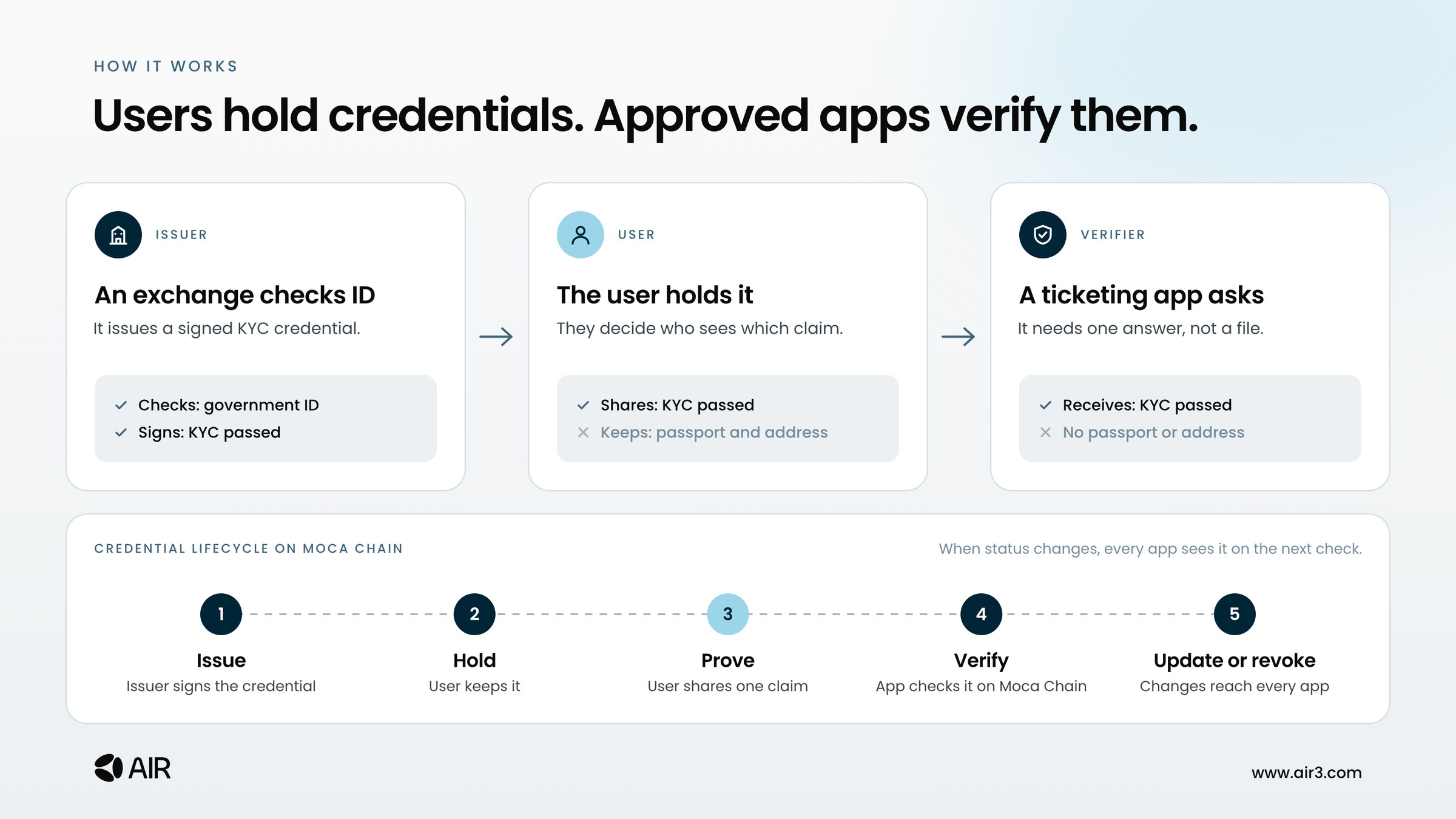
Three parties share one credential lifecycle:
- Issue. A trusted issuer, such as an exchange, retailer, ticketing platform or game, checks a fact about a user and issues a signed credential. The fact might be KYC status, a membership tier, ticket ownership or an in-game achievement.
- Hold. The user keeps the credential and decides who sees which claim.
- Prove. When an app asks, the user shares proof of only the claim needed. With selective disclosure, that can be “KYC passed” without the passport or address behind it.
- Verify. The app checks the issuer's signature and the credential's revocation status on Moca Chain. It gets the answer it needs while keeping its own data custody to a minimum.
- Update or revoke. When a user's status changes, the issuer updates or revokes the credential on-chain. The change takes effect within one block, about one second, so every app sees it on its next check.
Moca Chain records cryptographic credential hashes and metadata, which link to encrypted identity data held within its decentralized storage layer.
For businesses, this means fewer repeated checks and smaller stores of sensitive data. For users, it means fewer forms and more control over what they share.
Partners building with AIR
AIR is supported by a growing network of partners across consumer platforms, identity, fintech, loyalty, infrastructure, and agentic commerce. Together, they are helping businesses and users issue, verify, and use trusted credentials across real-world digital experiences, while expanding what can be built on Moca Chain.
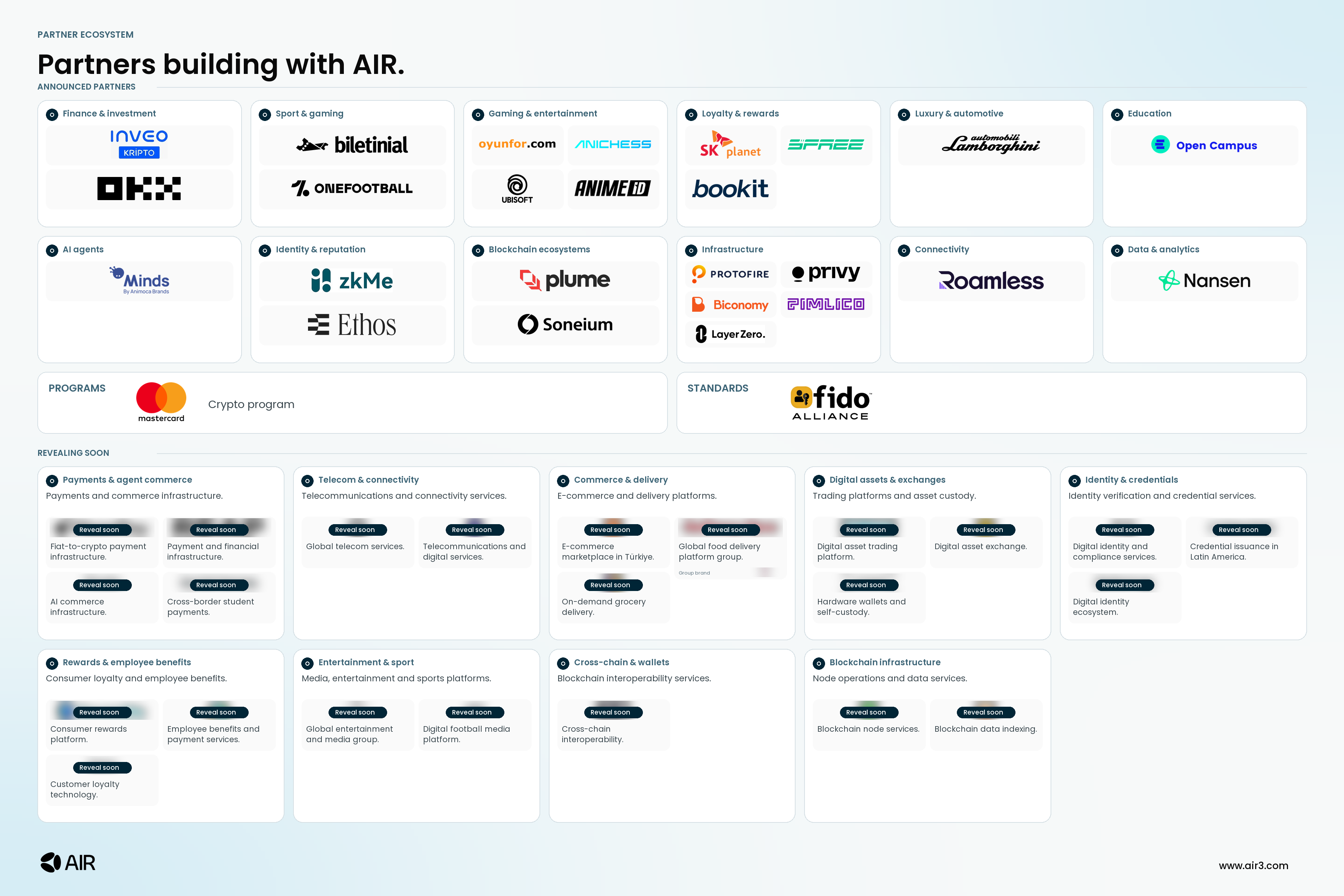
Figure 2. Partners building with AIR, with more to be revealed.
Digital identity standards and privacy
The privacy model reflects principles in the EU’s GDPR: collect only what the check needs, use it only for the stated purpose, share only with the user's consent and keep as few copies as possible. Similar principles appear in other regulations, such as India’s DPDP Act.
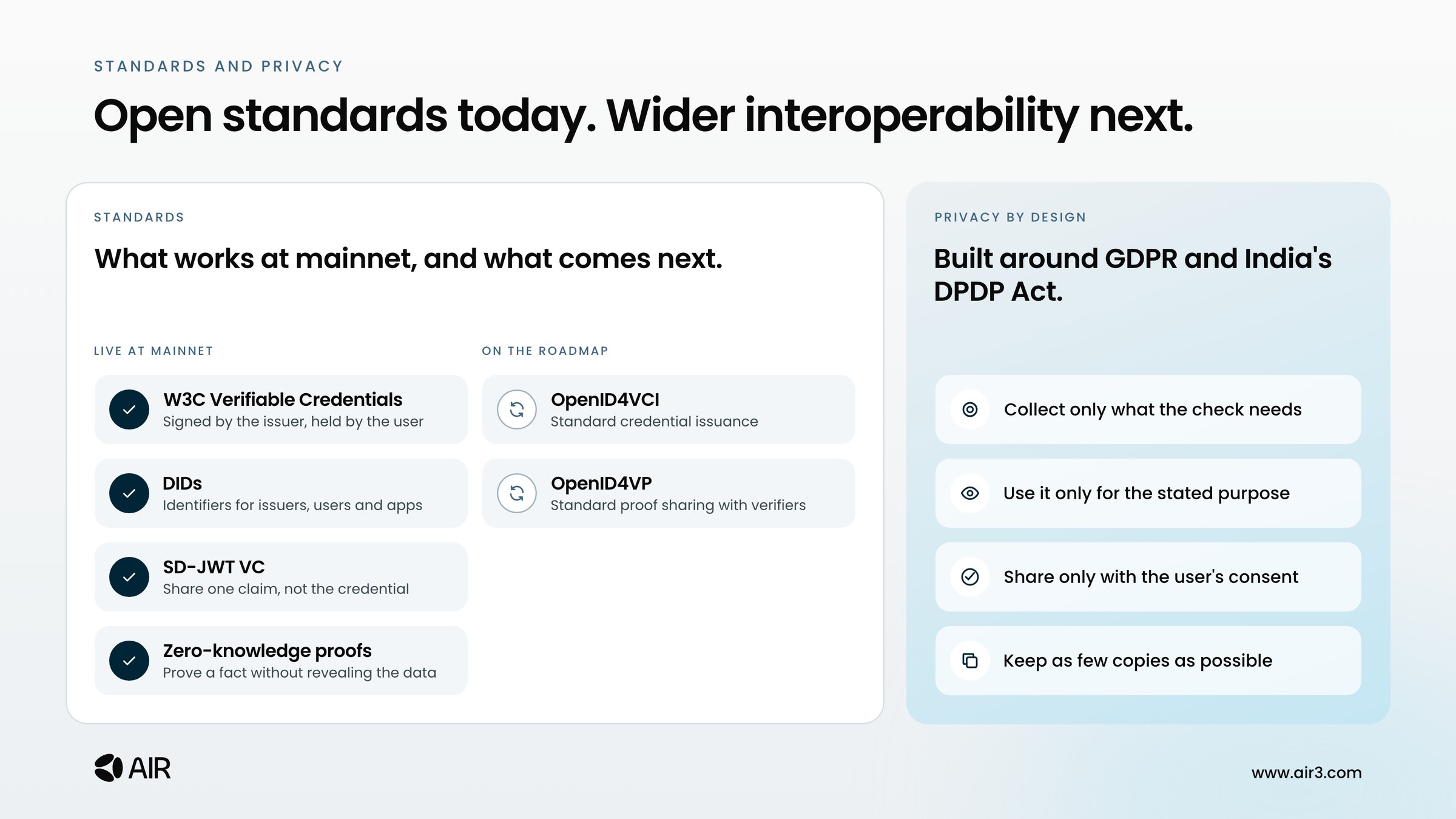
Moca Chain mainnet: what is live and what comes next
Live at mainnet
- A Layer 1 built on the Cosmos SDK, with CometBFT consensus and EVM execution
- MOCA as the native gas token, with a block explorer and a ChainList listing
- Credential issuance, verification, updates and on-chain revocation through supported AIR flows
- A built-in decentralized storage layer, the Moca Chain Storage Provider (MCSP) network
- Zero-knowledge proof verification
Expanding after launch
- OpenID4VCI and OpenID4VP support
- Broader cross-chain identity workflows
- Scoped, revocable delegation for AI agents
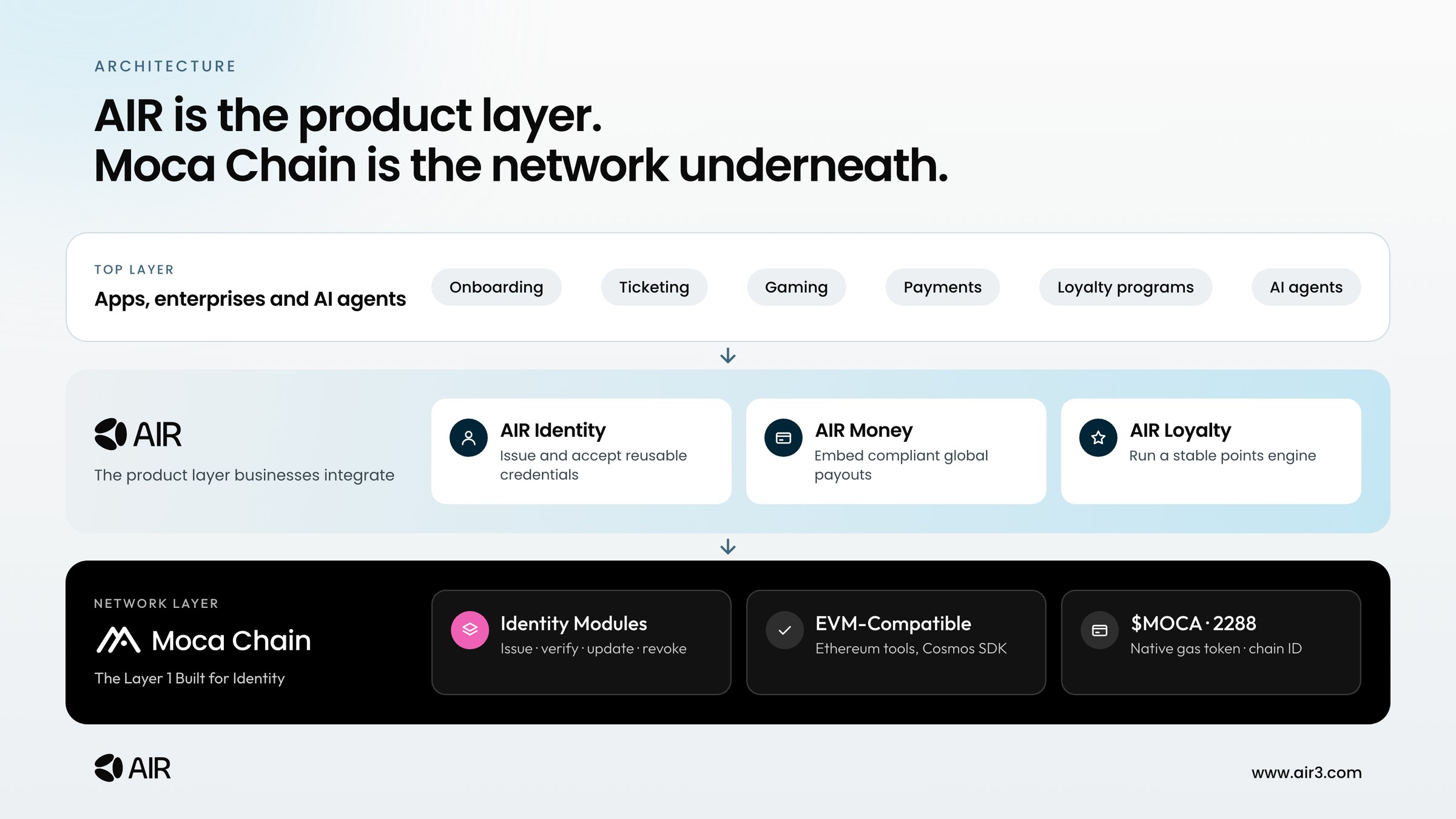
AIR: the digital identity product layer on Moca Chain
AIR is the integration suite businesses use to deploy identity on Moca Chain. A business can join the network in either role, and most will do both:
- As an issuer, a business turns checks it has already run, such as KYC, loyalty tier, membership or a ticket purchase, into credentials its users can carry to partner apps. Checks it has already paid for keep delivering value after onboarding.
- As a verifier, a business asks for the one proof it needs, whether for onboarding, eligibility, campaign access or Sybil-resistant rewards. That lets it acquire users who already hold the credentials it needs, with minimal data custody.
The same integration suite includes AIR Money, which embeds compliant global fintech payouts, and AIR Loyalty, a stable points engine for brands and merchants.
AI agent identity: on the roadmap
AI agents are starting to search, book and buy on people's behalf. To most merchants today, they look like just another bot.
AIR is extending its credentials to agents. A user will be able to link an agent to the credentials they hold in AIR and give it limited, time-bound, revocable authority. The agent can then prove three things: a known person stands behind it, its authority is still valid, and the requested action is within scope. A merchant can check that proof and extend the pricing, access or loyalty benefits that belong to that person.
This is a product direction, not a mainnet feature. Moca Network will share details as it ships.
Build on Moca Chain
Moca Chain is built on the Cosmos SDK with EVM compatibility. Solidity contracts, Ethereum wallets and familiar tooling work as developers expect, alongside native identity contracts for the credential lifecycle.
Get started
- Connect: add Moca Chain to your wallet through ChainList.
- Read: the AIR and Moca Chain documentation.
- Explore: transactions and contracts on the mainnet explorer.
- Build: start with the proof your app asks users for most often, then issue or accept it with AIR.
- Partner: Partner with us to grow your business.
What comes next
Mainnet is the foundation. Moca Network's build focus is now AIR:
- deeper integrations with partners
- credential coverage across more regulated and consumer markets
- the delegation rails that agentic identity will run on
All of it runs on Moca Chain.
The first phase of the internet asked users to create a new account everywhere. The next should let them carry trusted credentials with consent, privacy and control.
Moca Chain is live. AIR is where it gets built.
Frequently asked questions
What is Moca Chain?
Moca Chain is an EVM-compatible Layer 1 built for digital identity. It provides shared infrastructure for issuing, verifying, updating and revoking credentials, with MOCA as its native gas and governance token.
How is Moca Chain different from a general-purpose blockchain?
On a general-purpose chain, each application typically builds its own credential contracts, issuer lists, schemas and revocation logic. Moca Chain provides native identity contracts and a built-in storage layer so applications can use a shared credential lifecycle.
Is personal information stored on Moca Chain?
No. Moca Chain records cryptographic credential hashes and the metadata needed for verification. The underlying documents and personal attributes remain with the issuer.
What is the relationship between AIR and Moca Chain?
Moca Chain is the network underneath. AIR is the product and integration layer businesses use to issue and accept credentials, embed compliant fintech payouts, and operate loyalty programs.
How can a business use AIR?
Through AIR, a business can act as an issuer, turning checks such as KYC status, membership or ticket ownership into credentials. It can also act as a verifier, requesting a specific proof for onboarding, eligibility, access or rewards while minimizing its custody of personal data.
What identity standards are supported?
Moca Chain currently supports W3C Verifiable Credentials, DIDs, SD-JWT VC and zero-knowledge proof verification. OpenID4VCI and OpenID4VP support is on the roadmap.
What is live on mainnet today?
Mainnet is live with EVM chain ID 2288, MOCA as the native token, RPC access, a block explorer and a ChainList listing. Supported AIR flows can issue, verify, update and revoke credentials on the network.
Can Ethereum developers build on Moca Chain?
Yes. Moca Chain supports EVM execution, so developers can use Solidity, Ethereum wallets and familiar development tooling alongside its native identity infrastructure.
Is agentic identity live today?
Not yet. Scoped, time-bound and revocable authority for AI agents is a product direction on the roadmap, rather than a mainnet feature available today.
How do I get started?
Add Moca Chain through ChainList, read the AIR and Moca Chain documentation, explore activity on the mainnet explorer, or visit air3.com to discuss an integration.
Follow us on X and LinkedIn for the latest updates on Moca Chain and AIR.
Partner with AIR
AIR is one integration suite for identity, money and loyalty. AIR Identity lets trusted issuers issue verifiable credentials and businesses verify them, so acquisition starts with users who already qualify, with minimal data custody. AIR Money embeds compliant global financial infrastructure, opening new markets without building new rails. AIR Loyalty gives brands a programmable, stable-value points engine that keeps users coming back.
Partner with us to grow your business.
AIR is built by Moca Network, the identity network of Animoca Brands.




.png)
.png)