
Windows 11 Will Tell Apps How Old You Are, but Not When You Were Born
Microsoft has published documentation for a pair of Windows 11 APIs that give an app the signed-in user's age bracket without ever disclosing their age or date of birth. The docs went live on 27 August 2026, ahead of the feature itself, which Microsoft says will be enabled in a release later this year. Apple and Google shipped equivalents earlier in 2026, which means all three major consumer platforms will soon hand apps an age band rather than a birthday.
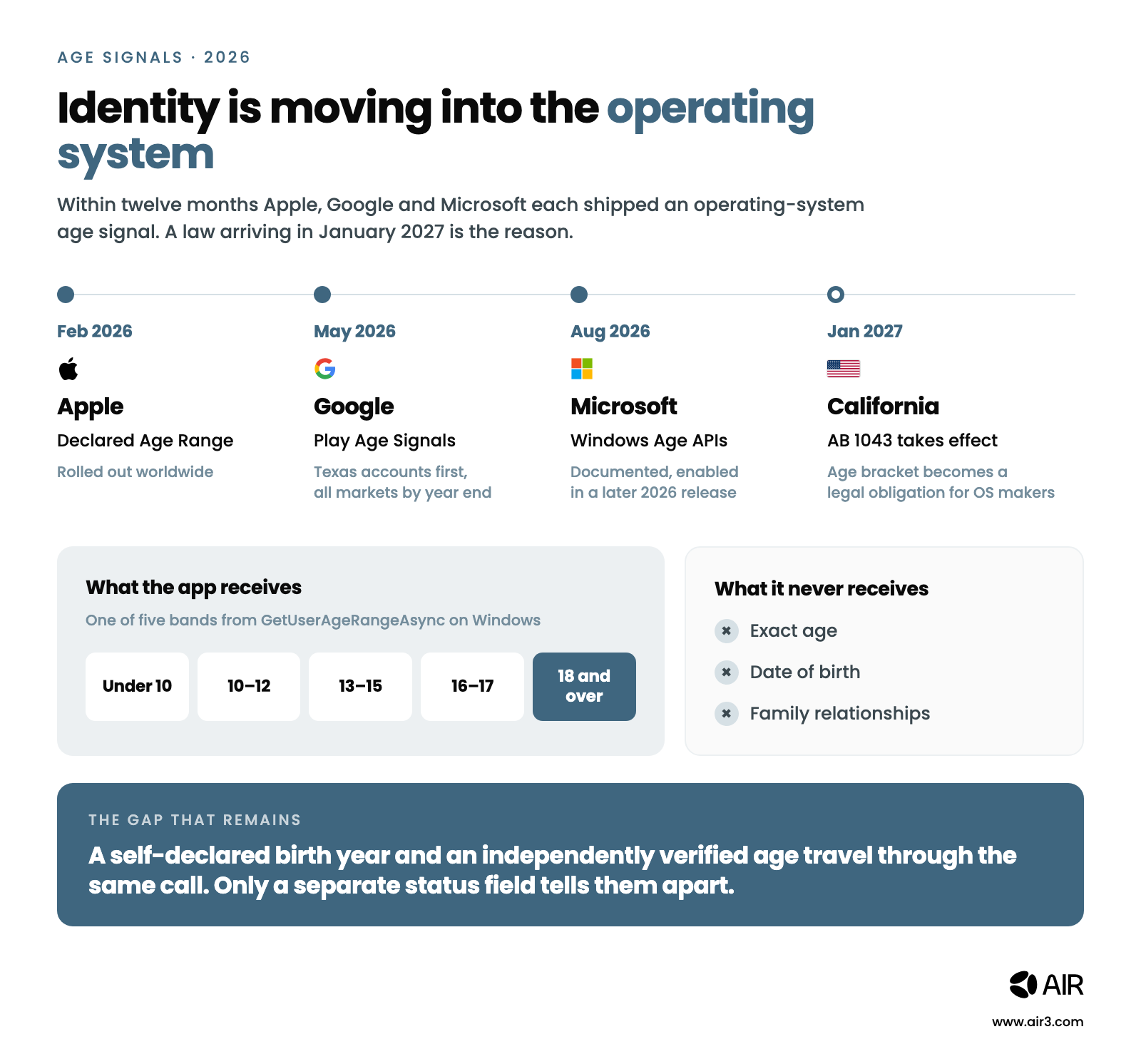
Key takeaways
- GetUserAgeRangeAsync returns one of five bands: under 10, 10-12, 13-15, 16-17, and 18 and over. It does not return an age, a date of birth, or family relationship details.
- A separate call, GetAgeVerificationStatusAsync, reports whether the identity provider actually verified that age. The two questions are deliberately kept apart.
- Apple's Declared Age Range API rolled out worldwide in February 2026; Google's Play Age Signals API began returning live signals for Texas accounts in May 2026 and is due in all markets by year end.
- The driver is legislative: California's AB 1043 requires operating system providers to collect age at device setup and pass a bracket to apps from 1 January 2027, with penalties of up to $7,500 per affected child.
- None of these APIs verify anything on their own. They standardise how an age attribute travels, not how much it can be trusted.
What the Windows APIs return
The Windows Age APIs sit in what Microsoft calls the Digital Safety platform. An app asks for a signal at the moment a user tries to reach age-restricted content, and Windows answers with a range rather than a value.
| Age group | Returned range |
|---|---|
| Under 10 | {0, 9} |
| 10-12 | {10, 12} |
| 13-15 | {13, 15} |
| 16-17 | {16, 17} |
| 18 and over | {18, INT32_MAX} |
| Unknown | null |
A null result is not an error condition to route around. Microsoft's guidance is that an app receiving it should fall back to its own default behaviour or age gate. Until the platform is switched on, every call returns exactly that.
The second call is the more interesting one. GetAgeVerificationStatusAsync reports whether the identity provider independently verified the user's age, returning Verified, Unverified, OptedOut, TemporarilyUnavailable or NotApplicable. An app can therefore distinguish between a 16-17 band that someone typed in and a 16-17 band that was actually checked, and decide how much weight each deserves.
Access is gated. The Digital Safety platform validates the calling application's identity before returning anything meaningful, which Microsoft says prevents one app from querying another app's safety settings. Beyond registration the requirements are narrow: Windows 11 as a minimum, a Win32 COM surface in C or C++, and a user session with a Microsoft account signed in.
Apple and Google got there first
Microsoft is completing a set rather than opening one.
| Platform | API | Status |
|---|---|---|
| Apple | Declared Age Range | Rolled out worldwide, February 2026 |
| Play Age Signals | Live for Texas accounts created after 28 May 2026; all markets due by end of 2026 | |
| Microsoft | Windows Age APIs | Documented 27 August 2026, enabled in a later 2026 release |
The designs converge on the same shape. The app receives a band, not a birth date, and receives some indication of where that band came from. Google's signal distinguishes whether the information rests on parental management, self-declaration, or age estimation. Microsoft splits the same distinction into a separate verification-status call. Apple exposes age category alongside parental consent signals.
Why now
The timing is legislative rather than voluntary. California's AB 1043, the Digital Age Assurance Act, was signed on 13 October 2025 and takes effect on 1 January 2027. It requires operating system providers to collect age information at device account setup and transmit an age-bracket signal to developers through covered application stores. The statute defines four brackets: 12 and under, 13-15, 16-17, and 18 and over. Penalties run to $2,500 per affected child for negligent violations and $7,500 for intentional ones.
Microsoft's five bands map onto those four, with the youngest split at ten. App Store Accountability Acts in Texas and Utah, with obligations landing from 1 January 2026, pushed Apple and Google to move first.
What it means for the identity industry
What has been standardised here is the transport of an age attribute, not the assurance behind it. All three platforms now provide a clean way to move a minimal claim from the operating system to an application without the application collecting a birth date, which is a genuine reduction in how much personal data ordinary apps end up holding. What none of them provide is a reason to believe the claim: a band derived from a self-declared birth year at device setup travels through exactly the same call as one that was independently checked, and only the accompanying status field separates them. That places the interesting problem one layer up. The question stops being how an application asks for an age and becomes which identity provider stood behind the answer, on what evidence, and whether a relying party in another jurisdiction has any way to evaluate that.
Frequently asked questions
What does the Windows 11 age signals API return?
GetUserAgeRangeAsync returns a UserAgeRange object with lower and upper bounds corresponding to one of five bands: under 10, 10 to 12, 13 to 15, 16 to 17, and 18 and over. It returns null when the age is unknown. It never returns the user's actual age, date of birth, or family relationship details.
Does the Windows age API verify a user's age?
No. The age range call reports a band only. A separate call, GetAgeVerificationStatusAsync, reports whether the identity provider independently verified that age, returning Verified, Unverified, OptedOut, TemporarilyUnavailable or NotApplicable. An unverified band carries no assurance on its own.
When will the Windows age signals APIs be available?
Microsoft published the documentation on 27 August 2026, ahead of availability, and has said the APIs are planned to be enabled in a release later in 2026. Until then every call returns an unknown age range and an unavailable verification status, so apps are expected to fall back to their existing age gate.
Do Apple and Google have equivalent age signal APIs?
Yes. Apple's Declared Age Range API rolled out worldwide in February 2026. Google's Play Age Signals API began returning live signals for Texas accounts created after 28 May 2026, with all remaining markets committed by the end of 2026. Both return an age band rather than a birth date, and both indicate the basis for that band.
What is California AB 1043?
AB 1043, the California Digital Age Assurance Act, was signed on 13 October 2025 and takes effect on 1 January 2027. It requires operating system providers to collect age information at device account setup and pass an age-bracket signal to app developers. It defines four brackets — 12 and under, 13 to 15, 16 to 17, and 18 and over — and sets penalties of up to $2,500 per affected child for negligent violations and $7,500 for intentional ones.
Related reading
- Age assurance accuracy standards
- Under-16 social media age verification
- Retroactive age verification for existing accounts
Sources: Microsoft Learn, Age signals overview for Windows developers, 27 August 2026; California AB 1043 (Digital Age Assurance Act); Apple Declared Age Range API; Google Play Age Signals API.
Partner with AIR
AIR is one integration suite for identity, money and loyalty. AIR Identity lets trusted issuers issue verifiable credentials and businesses verify them, so acquisition starts with users who already qualify, with minimal data custody. AIR Money embeds compliant global financial infrastructure, opening new markets without building new rails. AIR Loyalty gives brands a programmable, stable-value points engine that keeps users coming back.
Partner with us to grow your business.
AIR is built by Moca Network, the identity network of Animoca Brands.


.png)
.png)