1Password for Agents: What It Means for AI Commerce
1Password for Agents lets supported AI agents sign in to accounts with user approval without receiving the password. For businesses, the next challenge is recognising the customer behind the agent, checking what they authorised and applying the benefits they qualify for. These are the commercial questions AIR is built to address.
As AI agents take on more shopping tasks, businesses need to preserve the customer relationship throughout the transaction. A loyal customer should still receive their member benefits when an assistant shops for them. A spending limit should still apply when software handles checkout.
My view is that the commercial opportunity lies in making those relationships and permissions usable wherever a customer chooses to buy.
What is 1Password for Agents?
Announced on October 22, 2026, 1Password for Agents enables supported agents to request account access through 1Password. After the user approves, 1Password fills the credential directly into the destination website without exposing it to the agent.
Muse and Grok Bot integrations are rolling out. Claude Duet, ChatGPT Work and dots, and Townie integrations are listed as coming soon. Availability and safeguards vary by integration. Read 1Password’s announcement.
This addresses an important obstacle to delegation: letting an assistant use an account while keeping the password protected.
However, 1Password’s documentation also explains that an agent’s actions after sign-in depend on the agent and the website. A protected login does not, by itself, define every action the customer has authorised.
Why does AI agent identity matter for commerce?
Agentic commerce means AI agents helping people discover, evaluate or purchase products and services. When an agent reaches a merchant, several distinct questions arise.
- Agent identity and authentication: Which agent is making the request, and can it prove that?
- Customer delegation: Who authorised it to act on their behalf?
- Action authorisation: Does that permission cover this purchase now?
- Customer eligibility: Does this customer qualify for the requested offer?
- Payment approval: Has the payment provider approved the transaction?
These checks serve different purposes. Identifying an agent does not establish a customer’s membership tier. Confirming membership does not authorise a purchase. A customer’s purchase permission does not guarantee payment approval. AIR’s published guidance makes these distinctions central to evaluating agent-led orders.
For a merchant, the value comes from making the correct decision at each step: accepting an authorised order, applying a valid offer and asking for further approval when the request exceeds its limits.
What is AIR, and how does AIR Agent fit?
AIR is a modular integration suite built by Moca Network for identity, AI agents, financial services and loyalty. AIR Agent builds on AIR Identity to help businesses recognise the customer represented by an agent.
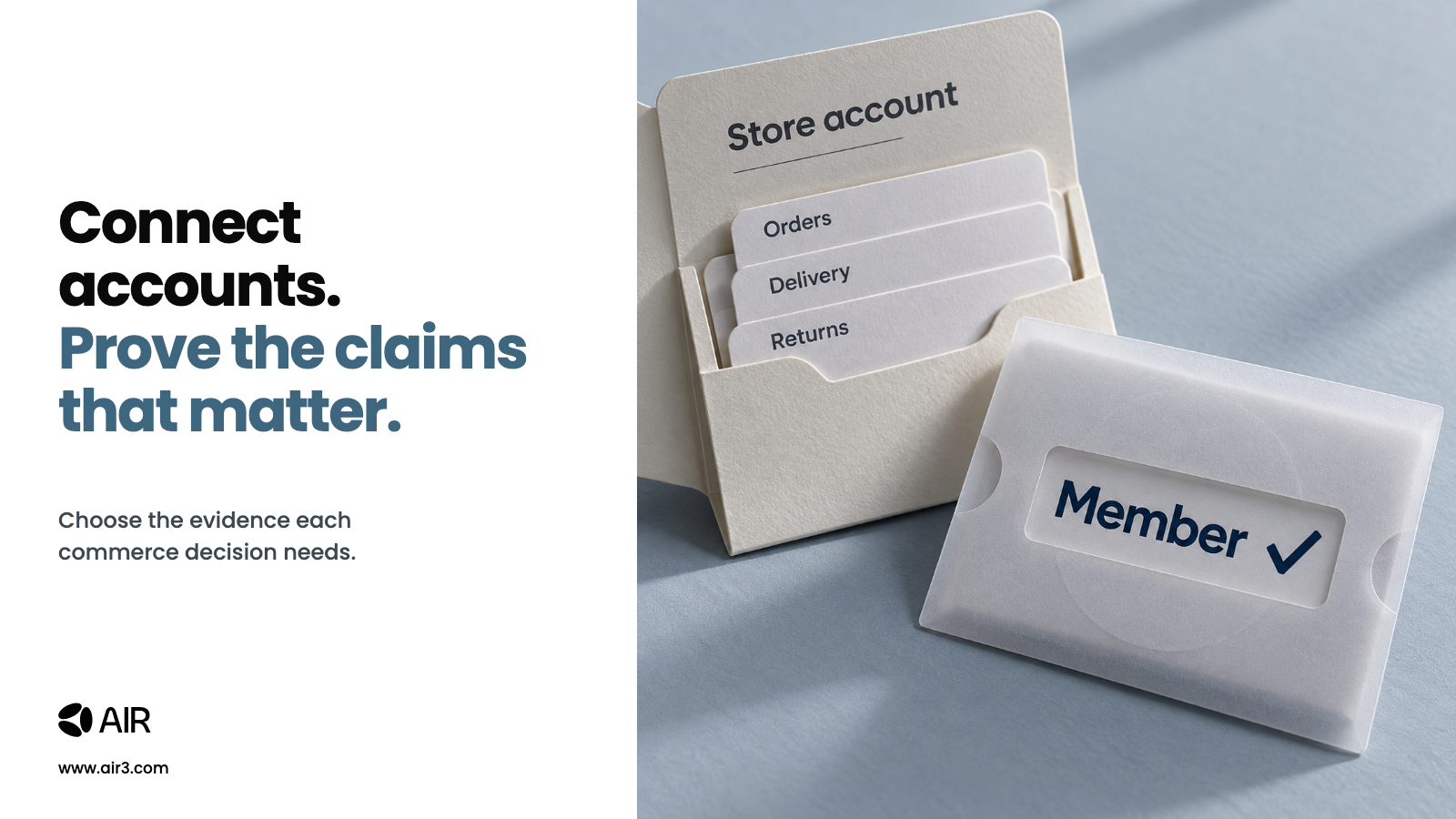
AIR Agent’s published model lets users choose which verified attributes an agent can present, such as membership status, and define limits on where and for how long it may act. A business can use the resulting proof to evaluate eligibility without requesting the customer’s complete underlying profile.
The distinction from password management is useful: 1Password addresses protected account access; AIR focuses on customer identity, eligibility and delegated authority in agent interactions. These functions could serve different parts of a commerce journey. This is a distinction between their roles, rather than an announcement of an AIR–1Password integration.
How can AIR create commercial value for businesses?
The strongest business case begins with a specific transaction problem. At AIR, I see four opportunities worth measuring.
1. Help eligible customers reach the right offer
An agent may arrive without the familiar signals a business uses to recognise a customer. If a merchant cannot verify membership or another entitlement, it may show only a generic offer.
AIR’s approach gives businesses a way to evaluate relevant customer proofs. The commercial hypothesis is straightforward: making an earned benefit available at the decision point could help more eligible customers complete a purchase.
The useful measures are offer-application success and completed purchases among eligible customers.
2. Make loyalty benefits usable when agents shop
A loyalty programme loses practical value if its benefits disappear when the member delegates a purchase.
Consider a hypothetical hotel booking. One room costs $220. Another costs $235 but includes breakfast and late checkout for an eligible member. The right choice depends on the customer’s preferences and entitlement, not just the public room price.
Verified eligibility can help an agent evaluate the offer the customer can actually receive. For the brand, the opportunity is to carry its investment in loyalty into a new purchasing channel.
3. Apply targeted offers more precisely
A business may want to reward existing members, reach a particular eligible group or extend a partner benefit. Those offers work best when qualification can be checked at redemption.
AIR’s credential-based approach is relevant here: businesses can request proof of a specific attribute rather than collect an entire customer record.
The commercial objective is better control over who receives an offer. Teams should measure eligible redemptions, promotion cost and contribution margin to establish whether the approach improves their economics.
4. Build additional revenue models around identity and loyalty
AIR’s commercial proposition also extends beyond agent checkout. Its published model includes credential-verification fees through AIR Identity and configurable loyalty economics, including issuance, redemption and tier upgrades. AIR Money services are supplied by licensed third-party partners, with associated commercial terms subject to provider agreements.
For a platform, this creates several potential ways to earn from services delivered to users and partners. The appropriate model depends on the use case, integration and demand; these are revenue opportunities, not guaranteed returns.
How could identity-powered agentic commerce work in practice?
AIR and Minds announced a partnership with Reap and Pivota on October 8 to develop personalised agentic commerce.
Under the proposed architecture:
- AIR supplies selectively shared identity attributes and earned entitlements.
- Minds interprets the user’s instructions and coordinates the journey.
- Reap supplies payment capabilities, including credentials constrained by merchant, amount and timeframe.
- Pivota supports product and merchant selection and order execution.
The announced starting point is a controlled demonstration involving one merchant. It should be understood as a development initiative, rather than evidence of a completed rollout or measured conversion uplift. See the Reap announcement and Pivota’s status note.
The commercial aim is concrete: allow a customer’s agent to use a legitimate benefit and complete an authorised purchase through the merchant’s existing commerce systems.
What should brands do to prepare for AI shopping agents?
Start with one customer journey where eligibility changes the offer.
A hotel could test member rates. A retailer could test loyalty-tier benefits. A marketplace could test a partner promotion.
Define what the customer may delegate, which proof the merchant needs, when another approval is required and how payment is authorised. Then measure whether eligible customers can complete that journey successfully.
From a marketing perspective, I would also examine whether an agent can understand the actual offer: total price, qualifying conditions, exclusions, availability and returns. A benefit has limited commercial value if the assistant comparing options cannot identify or apply it.
The opportunity for AIR is to help businesses turn verified customer relationships into usable commerce decisions. That means recognising eligibility, respecting permission and making earned benefits available at the point of purchase.
The customer relationship should remain valuable when the customer sends an agent.
Frequently asked questions
Does approving an AI agent’s login approve a purchase?
Login approval grants account access. Purchase permission must be evaluated against the customer’s instructions, the agent’s controls and the merchant’s transaction rules. Payment approval remains a separate decision.
How does AIR support personalised agentic commerce?
AIR’s approach connects verified customer attributes and delegated permissions to agent interactions. This gives businesses evidence they can use to evaluate eligibility and apply relevant benefits.
Is the AIR, Minds, Reap and Pivota purchase flow fully launched?
The partnership announcement describes a proposed architecture beginning with a controlled single-merchant demonstration. The cited announcements do not establish a broad production rollout or measured commercial results.
Where can businesses learn more?
Explore AIR Agent to discuss customer identity and delegated permissions, or explore AIR’s integration suite for identity, financial services and loyalty.
Partner with AIR
AIR is one integration suite for identity, money and loyalty. AIR Identity lets trusted issuers issue verifiable credentials and businesses verify them, so acquisition starts with users who already qualify, with minimal data custody. AIR Money embeds compliant global financial infrastructure, opening new markets without building new rails. AIR Loyalty gives brands a programmable, stable-value points engine that keeps users coming back.
Partner with us to grow your business.
AIR is built by Moca Network, the identity network of Animoca Brands.